Experimental particle physics · University of Warwick

Neutrinos, dark matter
and new ways to explore them.

We investigate how neutrinos change flavour, how they interact with matter and what they reveal—and obscure—in the search for dark matter. Our research brings original analysis methods into experimental use and develops detectors and novel precision-beam concepts, combining physics analysis, simulation and instrumentation to make new measurements possible.

Lu, Xianguo · Associate Professor of Physics · STFC Ernest Rutherford Fellowship (awarded 2019)

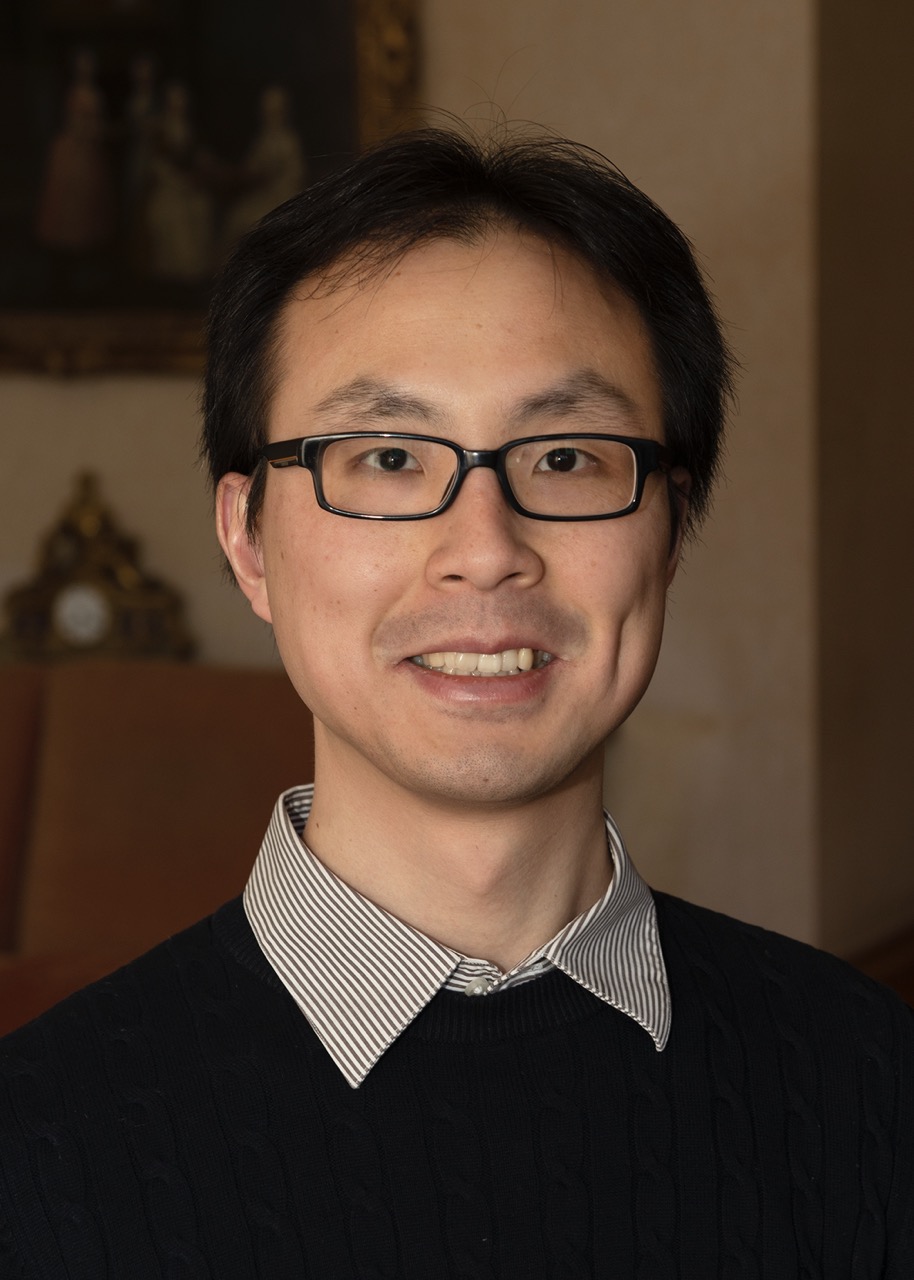
Portrait of Lu, Xianguo
Research programme

From neutrino physics to new experimental possibilities

Our research asks how neutrinos change flavour, how they interact with nuclei, and how their signals can be distinguished from dark matter. We approach these questions through complementary methods: VISOS makes oscillation physics visible, while TKI reveals nuclear dynamics through particle correlations. These ideas underpin a wider programme of measurements, modelling and analysis, including atmospheric neutrinos at JUNO and neutrino backgrounds in PandaX.

The same physics questions guide our development of future experiments. WarTPC provides a laboratory for gas-detector research, while our work on nuSTORM explores what precisely known neutrino beams could make possible. Together, these activities connect original methods and international experimental programmes with the practical work of designing, building and testing new instruments.

01 — OSCILLATIONS

VISOS: seeing flavour change

Making quantum behaviour visible. VISualisation of OScillation: three neutrino-flavour probabilities become a point in a triangle; their evolution traces a path. turns neutrino flavour change into geometric trajectories. I conceived VISOS and have led its development. Its interactive companion lets you explore how CP violation, matter and energy shape oscillations, connecting physical intuition with experimental questions.

03 — JUNO

Atmospheric neutrinos at JUNO

A new window on neutrino mass and mixing. Our programme connects atmospheric-neutrino measurements, nuclear models and rare-event searches. I founded JUNO’s first UK group and GeV ν-A high-eNergY MEDium Effect: JUNO’s working group on GeV-neutrino interactions and nuclear effects. Ganymede is also a moon of Jupiter, the mythological husband of Juno., its neutrino-interactions working group.

04 — PANDAX

Neutrinos at the dark-matter frontier

Understanding the neutrino fog. Our PandaX-20T programme investigates how neutrinos mimic dark-matter signals and shape future discovery sensitivity. Warwick’s group, among the experiment’s first international teams, connects neutrino-interaction expertise with rare-event searches.

05 — FUTURE DETECTORS

Warwick TPC Platform: advancing gas detectors

A platform for neutrino and rare-event physics. WarTPC connects new measurement ideas with detector capability. Our programme spans low- and high-pressure tracking, gas mixtures, optical and charge readout, and reconstruction, building beyond the AIDAinnova prototype deliverable.

06 — FUTURE BEAMS

nuSTORM: precision from stored muons

Precision beams for fundamental questions. nuSTORM would use stored muons to deliver precisely known neutrino beams, enabling electron-neutrino measurements essential to CP-violation searches.

The research group

Shared questions. Independent ideas.

We study neutrinos and dark matter, and develop new ways to investigate them. Our work brings together physics analysis, simulation and detector development, with students pursuing their own questions as part of a wider international research community.

Life in the group

The physics often takes us between data, calculations and the laboratory. A question arising in JUNO or PandaX may call for a closer look at neutrino interactions; a new measurement idea may lead to a test in WarTPC. Projects in T2K, DUNE and future beams offer further connections, with regular discussion helping ideas develop across the group.

Current students

Research areas and year of joining.

  • Matthew Snape · WarTPC · 2022
  • Yaoqi Cao · JUNO · 2023
  • Ziou He · JUNO · 2023
  • Wonjong Chang · nuSTORM · 2023
  • Hong-Kai Tan · WarTPC and PandaX · 2025
  • Jinxi Yan · JUNO · 2026

Doctoral graduates

PhD graduates, listed by completion year with their next destinations.

Kang Yang · 2023 · Oxford
Pion charge-exchange measurements with ProtoDUNE.
Imperial College London · LHCb

Komninos-John Plows · 2024 · Oxford
Heavy neutral leptons at MINERvA.
University of Liverpool · SBND

Federico Battisti · 2024 · Oxford
Kalman filtering and track reconstruction for large TPCs.
University of Bologna · DUNE

Weijun Li · 2025 · Oxford
Neutrino interactions and new physics with the upgraded T2K near detector.
IHEP · JUNO

Qiyu Yan · 2026 · University of Chinese Academy of Sciences
Nuclear effects in atmospheric-neutrino measurements and proton-decay searches.
University of Bordeaux · JUNO

Scientific leadership

Building programmes and research communities

Collaboration service

PandaX

  • Speaker Committee memberSince 2026

National strategy

STFC Particle Physics Advisory Panel

  • MemberSince 2025

Contributing to UK particle-physics strategic advice.

Programme building

JUNO

  • Founder and convener, GANYMEDE neutrino-interactions working groupSince 2022

Analysis leadership

T2K

  • Chair, Analysis Proposal Committee, Cross Section GroupSince 2020
  • Convener, Inclusive and Pion Production Cross Section Subgroup2018–2020

Detector development

AIDAinnova

  • Task leader for high-pressure gas TPC development2022–2025

Collaboration leadership

MINERvA

  • Physics Analysis Coordinator2020–2023
  • Executive Committee Member2020–2023
  • Speakers Committee Member2019–2023
  • Convener, Exclusive Neutrino Interaction Working Group2019–2020
  • Convener, Reconstruction and Algorithms Working Group2018–2019
Ideas in motion

Recent science and activity

OCTOBER 2026 · PANDAX

PandaX Speaker Committee

Joined the committee following appointment at the collaboration’s autumn meeting in Qingdao.

OCTOBER 2026 · SEMINAR TOUR

Neutrino physics: oscillations, interactions and future beams and detectors

Seminars at Shandong University, Peking University and the University of Chinese Academy of Sciences.

MARCH–OCTOBER 2026 · UK SEMINAR SERIES

JUNO: status and first physics results

Seminars on behalf of the JUNO Collaboration at Sussex, Rutherford Appleton Laboratory, Cambridge, Warwick and Manchester.

SEPTEMBER 2026 · KRAKÓW WORKSHOP

Neutrino science: the GeV-and-above case

Talk at the Ultra-cold Muons for the LHC Workshop, Kraków.

SEPTEMBER 2026 · SCIENTIFIC RETROSPECTIVE

Ten years of transverse kinematic imbalance

NuWro Workshop talk on the development, extensions and applications of TKI.

SEPTEMBER 2026 · NOW SESSION CONVENER

Neutrino masses, states and interactions

Co-convener with Elena Ferri of Session III at the Neutrino Oscillation Workshop (NOW 2026), Otranto. Programme ↗

JULY 2026 · WROCŁAW PUBLIC LECTURE

The quest to understand neutrinos: first results from JUNO

Public lecture at the University of Wrocław as part of its IDUB visiting-professor programme.

JUNE 2026 · CONFERENCE TALKS

First physics results from JUNO

Presentations on behalf of the JUNO Collaboration at PASCOS 2026, Sheffield, and the UK-APP Summer Meeting, Oxford.

Selected publications
Understanding the impact of nuclear effects on proton decay searches with the GiBUU modelQ. Yan, A. Takenaka, K. Gallmeister, X.-G. Lu, U. Mosel and Y. Zheng
Physical Review D 113, 095039 (2026)
· Paper ↗
Understanding neutrino pion production with the GiBUU modelQ. Yan, K. Wen, K. Gallmeister, X.-G. Lu, U. Mosel and Y. Zheng
Physical Review D 112, 093007 (2025)
· Paper ↗
A Kalman filter for track reconstruction in very large time projection chambersF. Battisti, M. Ivanov and X.-G. Lu
Computer Physics Communications 308, 109443 (2025)
· Paper ↗
The Ghent Hybrid Model in NuWro: a new neutrino single-pion production model in the GeV regimeQ. Yan, K. Niewczas, A. Nikolakopoulos, R. González-Jiménez, N. Jachowicz, X.-G. Lu, J. Sobczyk and Y. Zheng
JHEP 12, 141 (2024)
· Paper ↗
First combined tuning on transverse kinematic imbalance data with and without pion production constraintsW. Li, M. Roda, J. Tena-Vidal, C. Andreopoulos, X.-G. Lu et al. (GENIE Collaboration)
Physical Review D 110, 072016 (2024)
· Paper ↗
Show more publications (13 papers)
Modeling heavy neutral leptons in accelerator beamlinesK.-J. Plows and X.-G. Lu
Physical Review D 107, 055003 (2023)
· Paper ↗
Exploring neutrino–nucleus interactions in the GeV regime using MINERvAX.-G. Lu et al. (MINERvA Collaboration)
European Physical Journal Special Topics 230, 4243 (2021)
· Paper ↗
Deep Underground Neutrino Experiment (DUNE) Near Detector Conceptual Design ReportA. Abed Abud et al. (DUNE Collaboration)
Instruments 5, 31 (2021)
· Paper ↗
First T2K measurement of transverse kinematic imbalance in the muon-neutrino charged-current single-π+ production channel containing at least one protonK. Abe et al. (T2K Collaboration)
Physical Review D 103, 112009 (2021)
· Paper ↗
Probing nuclear effects with neutrino-induced charged-current neutral pion productionD. Coplowe et al. (MINERvA Collaboration)
Physical Review D 102, 072007 (2020)
· Paper ↗
Neutrino–hydrogen interactions with a high-pressure time projection chamberP. Hamacher-Baumann, X.-G. Lu and J. Martín-Albo
Physical Review D 102, 033005 (2020)
· Paper ↗
Nucleon binding energy and transverse momentum imbalance in neutrino–nucleus reactionsT. Cai, X.-G. Lu et al. (MINERvA Collaboration)
Physical Review D 101, 092001 (2020)
· Paper ↗
Pion–proton correlation in neutrino interactions on nucleiT. Cai, X.-G. Lu and D. Ruterbories
Physical Review D 100, 073010 (2019)
· Paper ↗
Identification of nuclear effects in neutrino and antineutrino interactions on nuclei using generalized final-state correlationsX.-G. Lu and J. T. Sobczyk
Physical Review C 99, 055504 (2019)
· Paper ↗
Characterization of nuclear effects in muon-neutrino scattering on hydrocarbon with a measurement of final-state kinematics and correlations in charged-current pionless interactions at T2KK. Abe et al. (T2K Collaboration)
Physical Review D 98, 032003 (2018)
· Paper ↗
Measurement of final-state correlations in neutrino muon–proton mesonless production on hydrocarbon at ⟨Eν⟩ = 3 GeVX.-G. Lu et al. (MINERvA Collaboration)
Physical Review Letters 121, 022504 (2018)
· Paper ↗
Measurement of nuclear effects in neutrino interactions with minimal dependence on neutrino energyX.-G. Lu, L. Pickering, S. Dolan, G. Barr, D. Coplowe, Y. Uchida, D. Wark, M. O. Wascko, A. Weber and T. Yuan
Physical Review C 94, 015503 (2016)
· Paper ↗
Reconstruction of energy spectra of neutrino beams independent of nuclear effectsX.-G. Lu, D. Coplowe, R. Shah, G. Barr, D. Wark and A. Weber
Physical Review D 92, 051302(R) (2015)
· Paper ↗
Opportunities

Join our research group

We welcome enquiries from prospective PhD students, postdoctoral researchers and visitors who would like to explore neutrinos, dark matter or new experimental methods with us. There are opportunities to work with data, develop simulations and build detectors, often within the same project.

PhD research

Projects span atmospheric neutrinos at JUNO, neutrino backgrounds in PandaX, nuclear interactions and gas-detector development with WarTPC. Get in touch to discuss which questions interest you and how they might develop into a PhD. See the University’s current funding calls, deadlines and eligibility requirements.

2027 PhD opportunities — INSPIRE advert ↗
October 2027 entry · Warwick experimental neutrino physics

Postdoctoral research and visitors

We are interested in collaborations that bring a fresh question, a complementary technique or a new experimental possibility. Prospective postdocs and visitors are welcome to discuss research ideas, fellowship applications and opportunities to work with the group.

2027 postdoctoral fellowship opportunities — advert (PDF) ↗
JUNO · PandaX-20T · WarTPC

Start a conversation

Write with a little about your interests and experience, and what draws you to the group. Please attach a CV; prospective PhD students should also include an academic transcript. A fully formed project proposal is not needed to begin a discussion.

Email Lu, Xianguo